PRISM

Predictive Recomposition vIa Semantic Latent DecoMposition

for View-invariant Video Representation Learning

1KAIST 2University of Illinois Urbana-Champaign
* Equal contribution ‡ Currently working at LG AI Research † Corresponding authors

EMNLP 2026 · Main Conference

Paper coming soon Code Model Demo

Abstract

Cross-view video representation learning aims to capture viewpoint-invariant action semantics despite substantial appearance changes across egocentric and exocentric videos. However, existing methods encode each video as a unified embedding, where view-invariant and view-variant semantics inevitably entangle under co-occurrences: a failure mode we show persists even in cross-view methods explicitly trained for view-invariance. Our key insight is that a view-invariant feature is truly disentangled when it can be sufficiently recomposed with an arbitrary view-variant feature while preserving their independent semantics. Building on this, we propose PRISM, that decomposes video into view-invariant and view-variant latents and recompose them under language supervision encouraging clean decomposition of the two streams. PRISM achieves state-of-the-art results on EgoExo4D, EgoExoLearn, AE2, even surpassing in-domain models under zero-shot setting.

Demo

Two minutes on how PRISM works

Insight

A truly view-invariant representation must be independently decomposed from view-variant semantics.

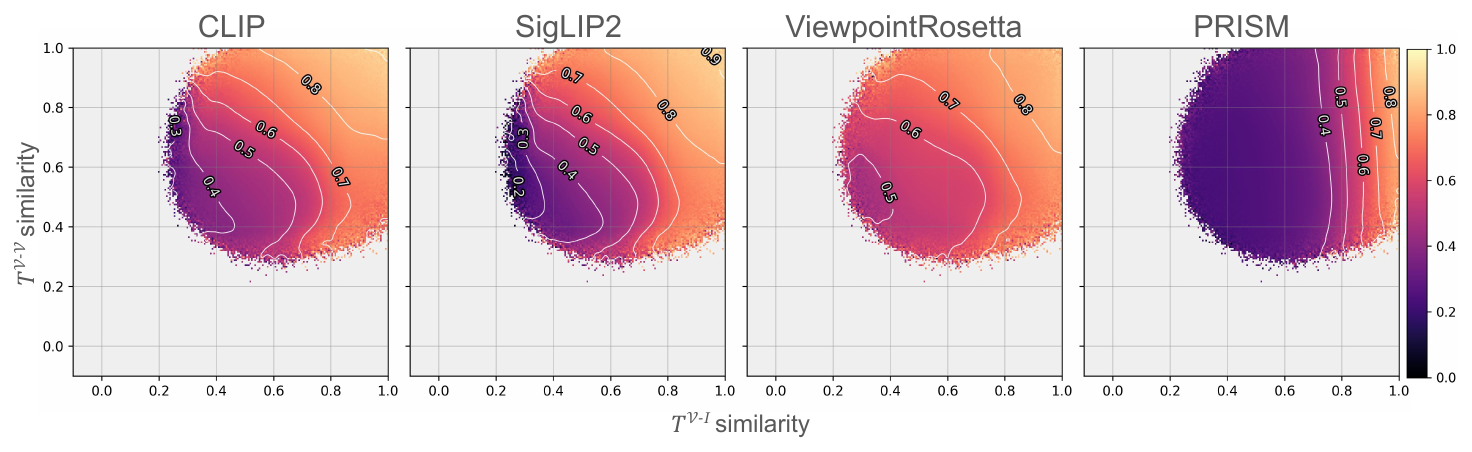
Previous works collapse a video into a single unified representation, which fails to prevent view-variant information from leaking in when a dataset exhibits a strong correlation between view-invariant (V-I) semantics and the underlying view-variant (V-V) content. If the V-I action “playing tennis” predominantly co-occurs with the V-V context “tennis court”, unified representations may rely on the shared contextual semantics rather than the action identity itself.
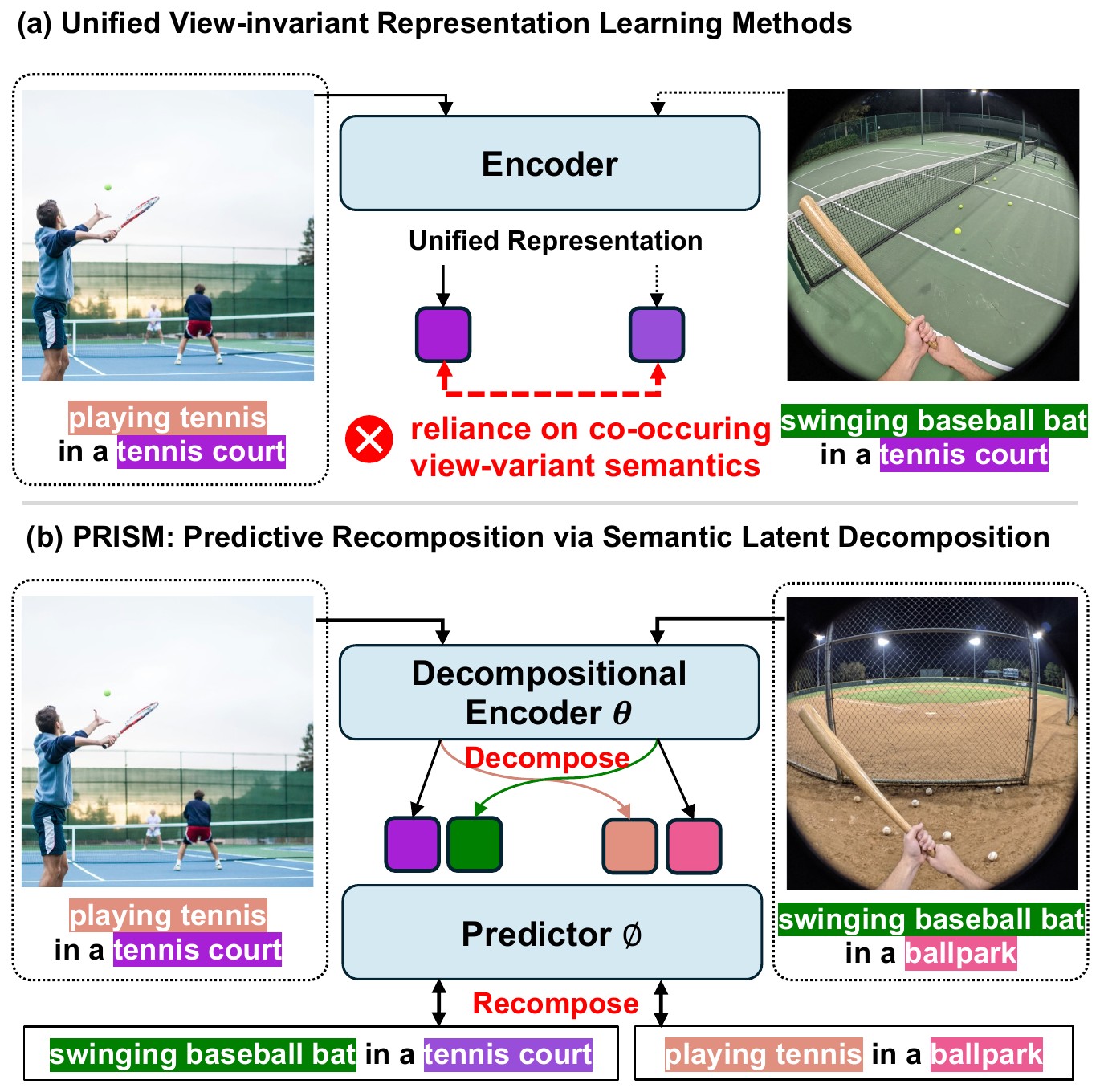
Figure 1: comparison of unified and compositional representations
Figure 1. Comparison of unified and compositional representations. (a) Unified representations entangle actions (playing tennis) with co-occurring context (tennis court), failing under novel compositions. (b) PRISM decomposes video into view-invariant and view-variant latents and recomposes them under language supervision, enforcing clean disentanglement.
Key insight

Such decomposition is only achieved when a model can freely recompose a V-I representation with an off-distribution V-V counterpart while still preserving the correct semantic meaning.

Which is what language is good for

⟦ ⟧

Language is compositional

Thanks to its inherently compositional structure, language naturally provides semantically controllable V-I / V-V compositions, enabling seamless decomposition and novel semantic recombination beyond observed visual co-occurrences.

Language is independent of viewpoint

Language captures high-level conceptual identity independently of the low-level visual variations induced by viewpoint changes.

Method

Decompose, then recompose.

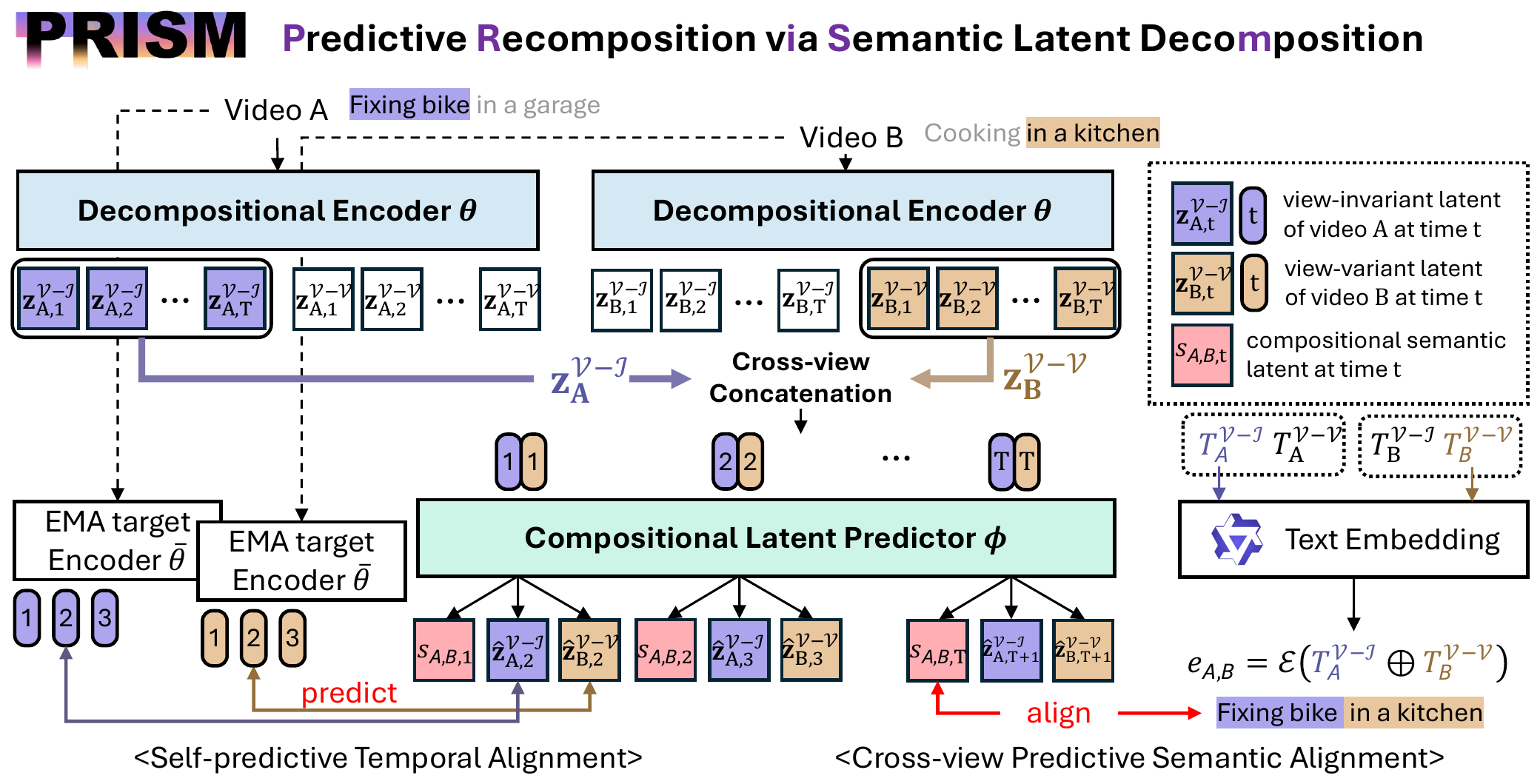
The core principle of PRISM is that visual information in a video can be decomposed into a view-invariant component V-I and a view-variant component V-V. If this decomposition is achieved cleanly, the V-I of one video should retain its semantic identity even when recomposed with the V-V of another video.

Decompositional Encoder θ

We feed an input video v into our Decompositional Encoder θ to separate the primary interaction V-I from the view-variant context V-V, producing two frame-level representations.

(zV-Iv,  zV-Vv) = θ(v) (1)

The decomposition happens per frame, and the two streams are then carried through time by a causal temporal transformer, so each keeps its own timeline.

input video
video v
Decompositional Encoder θ
zV-I
zV-V
t = 1T

Decompose-and-recompose schema

Once decomposed, we deliberately break each video’s natural co-occurrence through cross-composition. Given two independently sampled videos A and B, we perform cross-view concatenation by pairing zV-IA with zV-VB. This cross-composed pair is fed into the Compositional Latent Predictor φ to synthesize a compositional semantic latent.

sA,B = φ(zV-IA,  zV-VB) (2)

Language supervised decomposition

We combine the view-invariant description TV-IA of video A with the view-variant description TV-VB of video B, both generated through a pre-trained LVLM. A text embedding model then maps the recombined text into a target semantic embedding.

eA,B = (TV-IATV-VB) (3)

We then apply a contrastive objective that aligns the compositional latent sA,B with the recombined text embedding eA,B.

decomp = 𝔼A,B∈ℬ [ −log 𝕂(sA,B, eA,B) C,D∈ℬ 𝕂(sA,B, eC,D) ] (4)

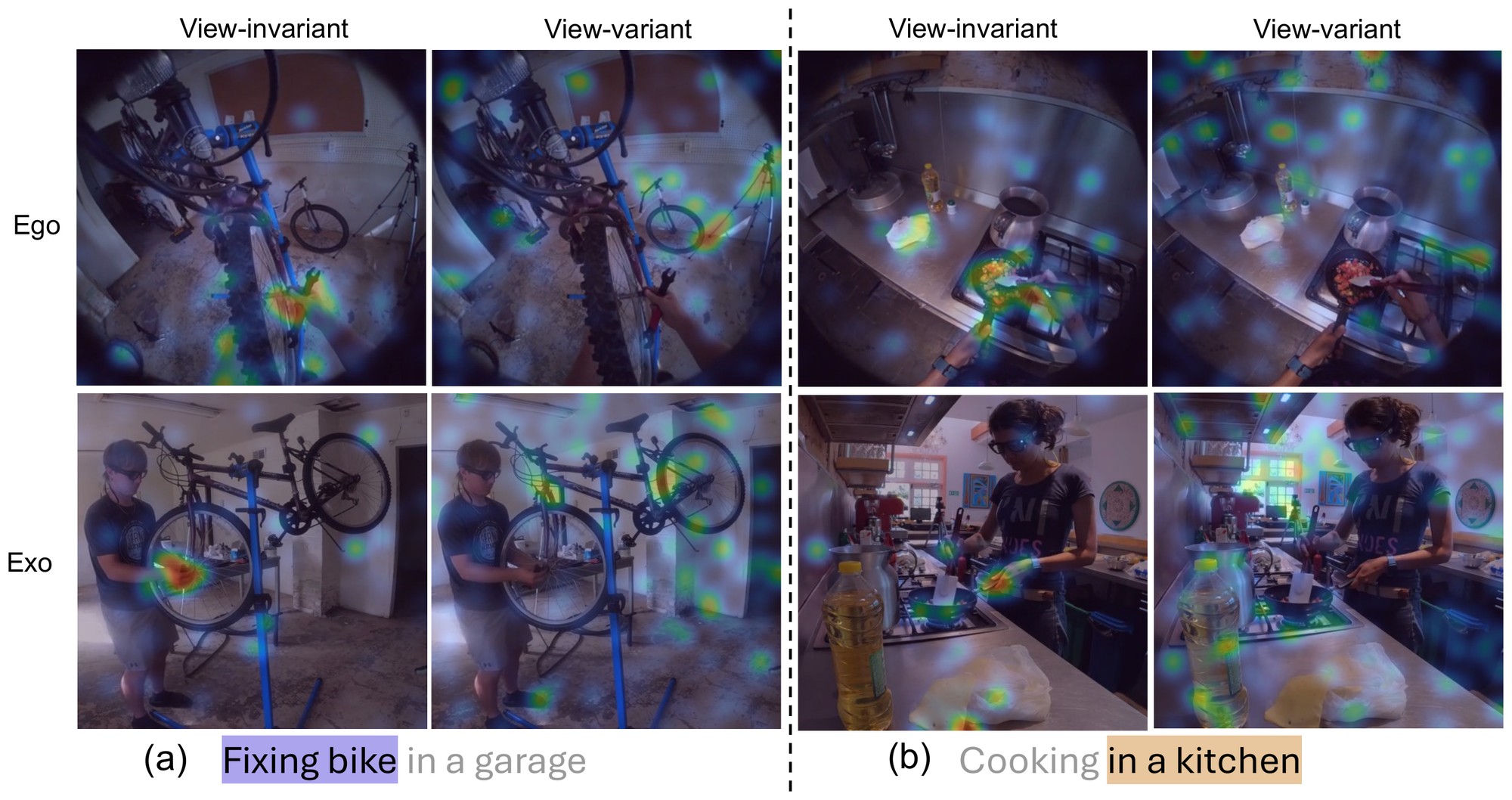
Intuitively, if φ relies on shortcut correlations in zV-V to infer the semantics of zV-I (e.g., kitchen → cooking), such dependencies become inconsistent under cross-composition and therefore cannot match the recomposed language target.

video A
zV-IA
zV-VA
video B
zV-IB
zV-VB
cross-view concatenation
Compositional Latent Predictor φ
sA,B
decomp
TV-IA TV-VB
playing tennis in a ballpark
Text Embedding
eA,B

Internalizing temporal dynamics

Clip-level linguistic supervision only provides coarse semantic summaries, such as “chopping an onion”. Consequently, it is insufficient for learning representations capable of capturing fine-grained frame-level temporal dynamics, such as “lifting a knifeplacing it on the onionslicing downward”.

To compensate for this limited temporal resolution, we introduce a self-predictive signal that tasks the predictor φ with forecasting the future outputs of the encoder θ.

(V-It+1,  V-Vt+1) = φ(zV-I≤t,  zV-V≤t) (5)

Since θ is continuously updated during training, using it directly as the target encoder would yield unstable supervisory signals and risk representational collapse. To provide stable learning targets, we utilize a target encoder θ̄, parameterized by an Exponential Moving Average (EMA) of θ’s weights.

θ̄αθ̄ + (1 − α)θ (6)
(V-Iv,  V-Vv) = θ̄(v) (7)

The temporal objective maximizes the cosine similarity between predicted and target representations, allowing each stream to capture its own temporal dynamics independently without relying on external alignment signals.

temp = 𝔼c∈{V-I, V-V} [−sim(ct, ct)] (8)

This objective incentivizes the encoder θ to embed temporal foresight into its representation space. Consequently, rather than merely capturing the present state, the representations at each time step naturally anticipate upcoming transitions.

zV-I
zV-V
t = 1T
observed ≤ t predicted t+1
predictor φ
EMA target θ̄
t+1 predicted
cosine
t+1 EMA target

We use orthogonal throughout in this semantic sense: the two streams are required to carry the disjoint language-level semantics of V-I and V-V, rather than to be geometrically orthogonal vectors.

Figure 2: overview of PRISM
Figure 2. Overview of PRISM. PRISM decomposes videos into view-invariant (V-I) and view-variant (V-V) latent streams, cross-composes them across videos, and aligns the resulting compositional latent with recombined language semantics. A self-predictive temporal objective further internalizes fine-grained temporal dynamics.
Results

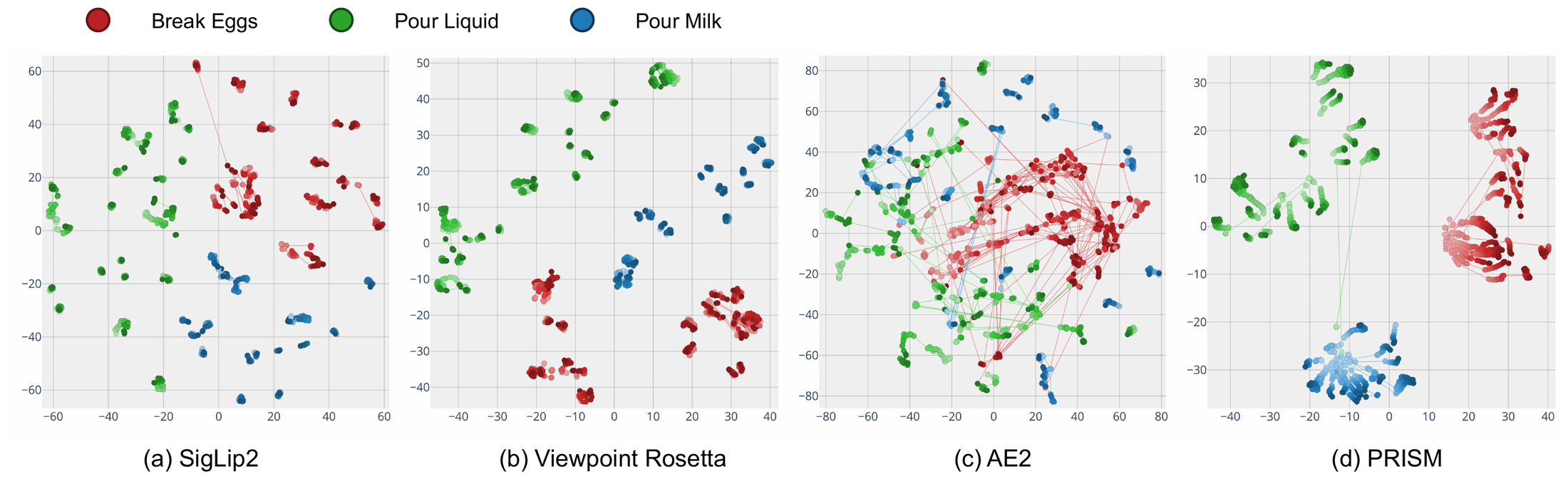
PRISM demonstrates the most significant improvements in Retrieval and Association, tasks that directly measure semantic equivalence across different viewpoints.

0.00
EgoExo4D Retrieval R@5 (avg)
+10.4 vs. ViewpointRosetta
0.00
EgoExo4D Recognition top-1
+7.46 vs. ViewpointRosetta
0.00
EgoExoLearn Association (avg)
+11.5 vs. ViewpointRosetta
0.000
AE2 Phase Ordering Kendall’s τ
zero-shot, above in-domain AE2 (0.562)
Method EgoExo4D EgoExoLearn
Retrieval (R@5) Recognition Assessment Associationtest Anticipation (R@5) Assessment
ego2exoexo2egoavg top-1top-5 ego2exoexo2egoavg ego-Vego-Nexo-Vexo-Navg
Image-Language Model
CLIP19.1112.2415.6810.4929.9054.9316.0015.6415.8233.5037.4039.6044.3038.7073.48
SigLIP235.0819.7227.4013.8637.8455.5725.0028.1026.664.7071.7056.9065.0064.6076.03
Video-Language Model
TimeSformer6.686.956.825.1814.1451.5815.0017.6416.3268.0975.1851.5761.9264.1975.47
InternVideo23.6420.6722.1613.6738.9952.5830.6021.7026.2063.7674.2856.6765.9265.1668.88
Ego-Centric Methods
EgoVLP29.3313.4721.4020.3346.3254.3731.5028.9030.2067.7072.5050.4052.0060.6569.04
LaViLa34.9112.0223.4726.4355.0154.1028.7025.7027.2075.6776.5848.0351.0562.8368.44
Cross-View Methods
ActorObserverNet29.5024.8527.1815.7038.4554.1011.9111.3611.6463.5061.6049.1050.3056.1368.59
VI Encoder29.5324.4026.9714.8535.3953.83---------
EgoInstructor46.0431.6838.8624.1551.4054.73---------
SUM-L47.1432.7739.9624.8352.0855.105.184.094.6461.461.7034.7024.2045.5065.31
ViewpointRosetta58.1447.2152.6834.4764.8555.8233.3631.2732.3266.4472.2152.8257.1062.1473.70
PRISM75.8950.2763.0841.9372.9255.2844.3643.3643.8672.7877.1562.5865.3369.4668.53

Cross-view semantic alignment on EgoExo4D and EgoExoLearn. We compare VLMs, ego-centric and cross-view methods. PRISM achieves new SoTA on Retrieval, Recognition, Association, and Anticipation. Bold = best, underline = second best.

On Skill Assessment, which evaluates execution proficiency within the same action class, PRISM yields a performance (55.28) comparable to ViewpointRosetta (55.82) and SigLIP2 (55.57). We attribute this to the fact that proficiency cues (e.g., hand tremors, movement fluidity) rely heavily on subtle visual nuances in execution style rather than the core semantic identity of the action. As a result, such fine-grained visual details are likely allocated to the V-V component during the decomposition process.

Method Frame Retrieval (mAP@10) Kendall’s τ Action Phase Classification (F1) Phase
Progression
regularego2exoexo2egoavg regularego2exoexo2egoavg
Random53.9751.6851.2052.280.00432.9033.4433.4633.27−0.069
Trained w/ AE2 videos (In-Domain)
ActorObserverNet50.4742.7041.2944.820.00236.1436.4031.0034.51−0.052
TCN58.2547.3742.4849.370.04656.8035.9241.4044.71−0.227
CARL56.4451.1447.8651.810.02552.2240.8543.1945.42−0.124
TCC70.5862.0865.8466.170.40067.1755.9052.2758.450.322
GTA72.4266.3965.4568.080.46469.6363.2970.4167.770.322
AE275.7872.5871.2573.200.56275.9671.0076.4474.470.480
Trained w/o AE2 videos (Zero-Shot Transfer)
ResNet-5058.2644.8742.9448.690.02553.5331.4745.2543.41−1.215
CLIP53.7047.3541.2747.440.04755.8339.3937.4644.23−1.212
SigLIP249.8745.5841.2345.560.02052.3938.0041.3343.91−1.322
SUM-L56.2039.7041.5045.800.11063.0043.8046.0050.930.030
ViewpointRosetta60.8053.5048.2054.170.04753.2039.0048.6046.93−0.150
PRISM77.7068.9065.0070.530.60179.6069.8071.3073.570.647

Fine-grained temporal modeling on the AE2 benchmark. We compare methods trained w/ and w/o AE2 videos. PRISM achieves new SoTA among methods trained w/o AE2 data. Bold = best among methods trained w/o AE2 videos.

PRISM surpasses the best in-domain model AE2 on Phase Ordering (0.601 vs. 0.562) and Phase Progression (0.647 vs. 0.480), while remaining within 3 and 1 points on Frame Retrieval and Action Phase Classification, respectively. This confirms that the self-predictive temporal objective internalizes fine-grained temporal dynamics without requiring any in-domain supervision.

Method #Params CLIP ViT-L/14 SigLIP2 Qwen3Embed Overall
R@10RSAR@10RSAR@10RSAR@10RSA
Vision Foundation Models
V-JEPA 21 B7.10.0557.70.0467.00.0467.30.049
DINOv21 B13.80.12114.20.10714.20.20914.10.146
Cross-View Methods
ActorObserverNet58 M6.60.0666.90.0656.70.0916.70.074
SUM-L126 M4.00.0393.90.0293.90.0563.90.041
ViewpointRosetta177 M7.50.0397.70.0647.30.1917.50.098
PRISM108 M14.70.11414.90.12815.10.30114.90.181

Robustness to action-scene disentanglement on the UNSCENE benchmark. PRISM surpasses both vision foundation models and cross-view methods. Bold = best, underline = second best.

UNSCENE features videos where the action contradicts the background context (e.g., fishing inside a bedroom). PRISM nearly doubles the best cross-view baseline ViewpointRosetta in both metrics (14.90 vs. 7.50 in R@10; 0.181 vs. 0.098 in RSA), while matching DINOv2 with only one-tenth of its parameters. This confirms that disentanglement fundamentally requires an explicit decomposition mechanism and cannot be trivially acquired by scaling alone.

Settings Cross-view Alignment Temporal Alignment
w/o ℒtempw/ ℒtempAvg w/o ℒtempw/ ℒtempAvg
Unified38.832.435.664.069.266.6
Decomposed50.953.552.265.972.169.0
Avg44.943.0-65.070.7-

Contribution of training objectives. Unified encodes a video into a single embedding, whereas Decomposed splits it into V-I and V-V streams that are cross-composed across videos. Decomposition drives cross-view alignment while ℒtemp drives temporal alignment, and combining both achieves the best on both axes.

Settings Cross-view Alignment Temporal Alignment
ego2exoexo2egoAvg Frm. retrieveAct. phaseAvg
Supervision w/ Ego-Exo Pairing
ActorObserverNet20.718.119.444.834.539.7
ViewpointRosetta45.839.242.554.246.950.6
Supervision w/o Pairing (PRISM)
Exo only + Gemini52.244.348.269.473.071.2
Ego + Exo + Qwen59.446.352.969.274.571.8
Ego + Exo + Gemini60.146.853.570.573.672.1

Sensitivity to training views and captioner choice. PRISM with exo-only data still surpasses all baselines on cross-view alignment, and substituting the captioner introduces only noise-level differences.

Analysis
Limitations stated in the paper

Captioner ceiling. Our semantic decomposition is inherently upper-bounded by the quality of the pre-trained LVLM captioner that provides the language-level supervisory signal. Swapping the captioner introduces only noise-level differences, but this robustness holds only across individual model choices. If a systematic bias is shared across LVLMs, such bias would propagate directly into the decomposed supervision targets and impose a quality ceiling on the encoder’s disentanglement.

Activity domain. All benchmarks evaluated in this work center on procedural human activities involving physical object manipulation (e.g., cooking, sports). This leaves non-human activities and human interactions that lack tangible physical manipulation unexplored.